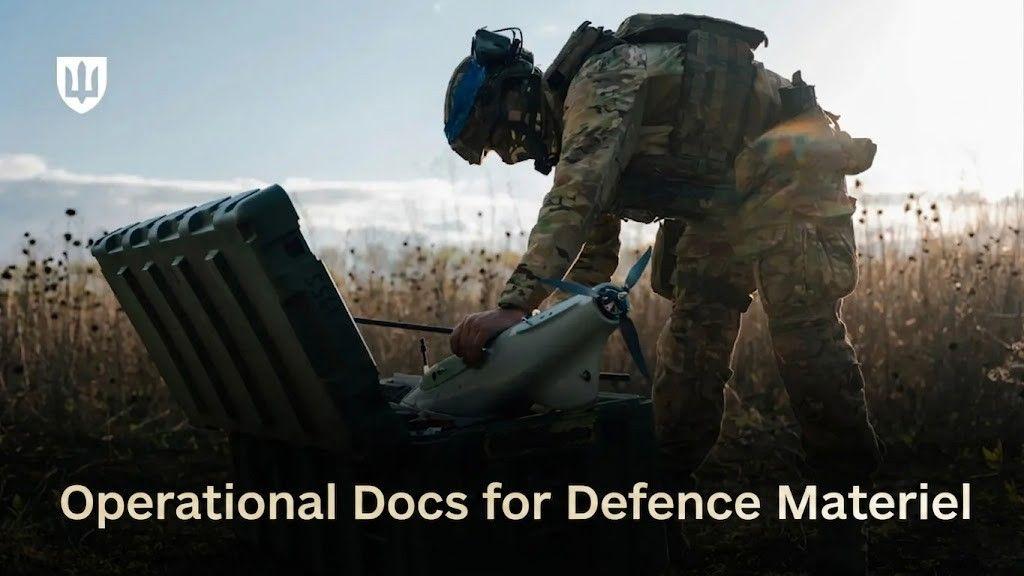
The Ministry of Defence has outlined the specifics of drafting operational documents for new weapons and military equipment.
Every item of defence materiel must be accompanied by operational documents. These are prepared by the developer during the drafting of working design documentation.
The types, content and general requirements for operational documents are specified in the National Standard DSTU GOST 2.601:2006 “Unified System of Design Documentation. Operational Documents.”
There are twelve core operational documents:
1. User Manual
Contains information on:
- product design
- operating principle
- product characteristics
- component characteristics
- guidelines for safe and correct use (application, maintenance, minor repairs, storage, transportation)
- condition assessment methods for maintenance and repair decisions
- disposal information regarding the product and its components
2. Installation, Commissioning, Adjustment, and Trial Guide
Provides the details required for the assembly, set up, launch, adjustment, trial operation and handover of the product and its components into service.
3. Product Logbook
Records:
- manufacturer warranties
- key parameters and characteristics
- technical condition data
- certification and disposal details
- in-use notes (running time and conditions, maintenance, repairs).
4. Product Passport
Contains:
- manufacturer warranties
- key product parameters and characteristics
- certification and disposal details
5. Product Label
Records:
- manufacturer warranties
- key product parameters and characteristics
- certification details
6. Parts and Assemblies Catalogue
Lists parts and assemblies with illustrations, showing their quantity, position inside the product, interchangeability, design features, and materials.
7. Spare Parts Consumption Rates
Provides the designations and quantities of spare parts used during the product’s service life.
8. Material Consumption Rates
Provides the designations and quantities of materials used during the product’s service life.
9. Spare Parts, Tools and Accessories List
Details the designations, applications, quantities and storage locations of spare parts, tools, accessories and materials used during the product’s service life.
10. Technical Training Posters
Present illustrated information on product design, operating principles, usage methods, maintenance procedures, and relevant technical knowledge.
11. Special Operating Instructions
Contain specific requirements relating to intended use, maintenance, minor repairs, storage, transportation, and disposal. These may be issued as separate operational documents or as annexes.
12. Schedule of Operational Documents
Specifies the complete set of operational documents supplied with the product and their storage locations.
Tailoring the kit: A UAS example
Not every item of materiel must be supplied with all twelve operational documents.
Any specific set of required operational is determined by DSTU V15.501:2021. The standard contains the general requirements for the designations, structure, content, presentation, publication and revision of operational and repair documentation for defence products.
Standards are distributed by the national standardisation body at uas.gov.ua.
The final list of operational documentation is decided by the developer on agreement with the customer. For instance, an unmanned aircraft system would require the following operational documents:
- Flight Manual
- User Manual
- Product Logbook (for the entire system)
- Product Passport (for the UAV)
- Schedule of Operational Documents
- Spare Parts, Tools and Accessories List